Wednesday, January 3, 2018

It's Been a Long, Long Time...

To all my former students:

It has been a while since I've posted here--mostly because I kept a separate blog at my former school, the Brooklyn School of Inquiry, and also communicated with students through Google Classroom.

I started at a new school in September 2017. It is called Brooklyn Arbor and it is in Williamsburg. I now teach fifth grade science AND social studies. Imagine that! I also use Google Classroom at Brooklyn Arbor and therefore have not been on the blog much. But it is really exciting when former students check into the blog and reach out to me. It is always GREAT to hear from you all. I think of you often and wonder how you're doing.

I still love nature! I still love gardening! I still love teaching! My sons have grown up. My eldest is a sophomore at Carnegie Mellon University. My youngest is in his senior year at Beacon High School. We will soon be hearing from colleges for him.

Can you believe how much time has gone by?  Please don't hesitate to reach out to me. I always love to hear from you all. (This is a recent photo of me during an environmental trip with my fifth graders. This is a team building activity that we did!)


Tuesday, June 27, 2017

Welcome BSI!

I'd like to welcome all my incredible BSI students to my blog. I haven't written on it in a couple of years, but since I will be moving on to another school--the Arbor School (PS 414) in Williamsburg, this is a great time to reboot my blog and keep in touch with each and every one of you!

As usual, I will share my love of science and nature with you all. In turn, I'd love to hear about your adventures and noticings. Don't be shy...share!

All of Ms. Seitz's classroom pets have found homes: Salt is with Ivan Bondar, Turtle 1 is with Nicholas Marchese, Turtle #2 is with Nicholas and Lucas Jung, and Turtle #3 is with Ami Epstein. The crayfish will be moving in with Alessandro Mazzoleni.

As you know, the one and only Guadalupe is also moving on. She is the best Teacher's Assistant a teacher could ever dream of having. She made my year more manageable, organized and brought a level of peace of our science room. I owe a lot to Guadalupe and wish her much success and happiness in the coming years. Let's give it up for Guadalupe!!!!


Monday, May 25, 2015

Nature in the Poconos

It has been a while since I've posted. I guess the too-long-winter kept me away. But now it's spring and I'm back out in the garden and investigating nature wherever I may be.

This Memorial Day weekend, I traveled with my family to the Poconos and came across some pretty amazing things during a nature walk--the Tumbling Waters trail, which we picked up at the Pocono Environmental Education Center. My first find was a familiar friend, the millipede who I found after turning over a decomposing log...one of my very favorite things to do. If you've read any of my earlier posts, you know that I've had previous experiences with millipedes, learning the hard way that they release a noxious liquid that stains your hands if you hold them for too long, say, during a hike. So this time, I left the little guy alone and simply took photographs.

Photo by Sharon Seitz

They curl up to protect themselves. They are really quite sturdy and quite beautifully striped--burgundy and dark brown with feathery maroon legs. Millipedes have two pairs of legs on most body segments. Despite "milli" in their name, millipedes do not have 1,000 legs, but common species have anywhere from 36 to 400 legs. The variety I saw is called Narceus americanus commonly called the American Giant Millipede, because it can grow to four inches long.

On this same trail, and to my amazement, I came across not one, but two solitary pink lady's slippers, which is a member of the orchid family. It is really, really rare to see one of these showy flowers in the wild. First of all, it takes many, many years for a seed to become an adult plant. Also, plant collectors like to dig them up and take them home because they are so unusual-looking. And lady's slippers can't grow without the help of a certain fungus and bumble bees.
Photo by Sharon Seitz


The lady's slipper seed does not have a food supply inside it, like most seeds do. It needs the threads of a fungus in the Rhizoctonia genus to break open the seed and attach themselves to it. The fungus will pass on food and nutrients to the lady's slipper seed. The plant will return the favor to the fungus when it is older. The fungus can soak up nutrients from the lady's slipper that it could not get by itself.
Photo by Sharon Seitz


Because the lady's slipper is a closed flower, it takes a strong insect to get inside. The flower smells sweet, so the bumble bee is tricked into thinking it holds nectar. When the bee gets inside it not only finds no nectar, but it realizes it is trapped. It cannot get back out the way it got in. The bumble bee explores and find a new way to squeeze out of the flower. To do so, it must push past the pollen-covered stamen. If the bee gets tricked by another lady's slipper, it will deliver pollen from the first flower, and get covered with pollen again by the new flower. The bee may do this several times before it figures out to avoid lady's slippers. The bee gets nothing out of the relationship but the plant could not make new seeds without the bee.

Another animal I saw was Glyptemys insculpta or the Wood Turtle. I just found this reptile during a walk on the grounds of the Fairway Villas in Bushkill, where we were staying. The guys had just finished playing basket and were blobbing, but I was aching to go for a walk. So I took my camera and started photographing wildflowers. I was walking on a path when I came across the turtle basking in the sun. At first, I thought it was a tortoise because it wasn't in the water and it looked kind of dry. It wasn't until I got home and did a few minutes of research that I discovered the turtle was a Wood Turtle, a species of special concern in Pennsylvania and New York. Needless to say, when I texted a photo of this cool turtle to the guys, they immediately left the villa and met me with their cameras and couldn't stop photographing this handsome turtle.

Photo by Sharon Seitz

Photo by Sharon Seitz

Sunday, January 25, 2015

Red-Tailed Hawk Sighting!

I could hardly believe my eyes. Perched on a neighbor's shed, adjacent to the back of my yard, stood a gorgeous red-tailed hawk clutching a male house sparrow with its talons. This kind of stuff doesn't bother me...after all I do teach the food chain to fourth-grade students and I know that this kind of behavior isn't mean or bad, it just keeps nature in balance.

So I ran to the dining room, unzipped my camera bag and pulled out my trusty Canon Rebel. It was freezing outside but I went out barefooted and in my pajamas because I didn't want to miss an opportunity for a close look and a great photo! I walked slowly toward the hawk, noticing the teardrop design of its breast and the stern expression of its yellow eyes, and the hawk just stood there unfazed by me. When I got close enough, I stopped and just watched. The hawk pulled at the bird's innards, devouring bits and pieces, and I just kept snapping.

When my feet started getting numb, I went inside to warm up, happy to have these pretty cool photos of a red-tailed hawk in my backyard. Wishing you many adventures in nature -- Ms. Seitz


Thursday, January 15, 2015

Cornell Lab of Ornithology Bird Cams

One of my anonymous viewers has asked for the link to the bird cams. This is the camera in Ithaca and this is the link to the overall site which has several cams you can check out!

Thursday, January 1, 2015

Life at the Feeders

During winter, it can be difficult for birds to find the food they need to survive. That's why I've put up a bird feeding station in my yard! It has four feeders. One of them is a suet feeder, which woodpeckers like, but I haven't yet seen a woodpecker.

Female Cardinal
 I was inspired to build my own station by the bird feeder cams on the Cornell Lab of Ornithology's allaboutbirds.com website. The cameras are focused on a bunch of bird feeders in Ithaca, NY and Ontario, Canada. Right now, my fifth-graders at the Brooklyn School of Inquiry are tuning into the Ithaca feeders and recording their observations. These observations will inspire questions that they can investigate on their own. For example, "What types of seeds do goldfinches prefer?" or "What time of day is busiest at the bird feeders?"

Male House Sparrow
These photographs feature some of the birds that have visited my backyard feeders so far. I plan on diversifying my food options to see if I can attract some other species, so stay tuned! Right now, I'm featuring black sunflower seeds and suet. No one has noshed on the suet yet.

White-Throated Sparrow
Female House Sparrow


Blue Jay
White-Throated Sparrow


Sunday, November 30, 2014

Meet George!

This Thanksgiving weekend, we hosted a special guest at the Miller-Seitz home....George, the Russian Tortoise. Isn't he handsome? George belongs to one of my students at BSI and is currently living in Room 409. Not wanting George to be all alone for four days, I carried him home and he's settled nicely into his corral in the dining room. It's especially fun watching George eat lettuce. He stretches his neck out so long and just chomps away.

Russian tortoises make great pets. They don't get any bigger than 9 inches, with males smaller than the females. They also live 50+ years! They are able to recognize their owners, which makes for a nice relationship.

Saturday, October 25, 2014

The Beauty of the Black and White Warbler

One of my favorite migrating birds is the black and white warbler. I think it's because they're easy to spot! I get all confused with the yellowish and greenish warblers that are flying through right now en route to their wintering grounds. They look so similar, but the black and white warbler stands out! At this time of year, the black and white warbler is heading to northern South America. What a long trip for a tiny bird! Be safe little warbler.

The black-and-white warbler is the only member of the genus Mniotilta, which means “moss-plucking” and refers to the bird’s habit of probing for insects. It you know what a nuthatch is, well, this bird behaves a lot like a nuthatch, creeping up and down tree trunks and along limbs while probing between bark fissures in search of insects and grubs. With unusually long hind toes and claws, these birds are well adapted to climbing on tree bark. Ya gotta love those ADAPTATIONS!

Interestingly, these warblers build their nests on the ground—at the base of a tree, rock, stump, or fallen log, or under a bush or shrub.

While still pretty common, black and white warblers are slowly declining in population mostly because of habitat fragmentation. And because they migrate at night, they frequently crash into windows, towers and wind turbines. Also as insect eaters, they are vulnerable to pesticide poisoning.To hear its beautiful song, CLICK HERE

Sunday, October 19, 2014

A Sense of Wonder Continues........


        It has been a while since I've written on the blog. Starting at a new school has occupied a lot of my time.
          I also wondered whether or not to continue the blog as it was so connected to my time as a teacher at P.S. 230, a school that has shaped me as an educator and whose students will always be close to my heart.
          I believe in the interconnectedness of everything, so the blog will continue--preserving the link I already share with former students at P.S. 230 and establishing a relationship with my new students at The Brooklyn School of Inquiry.
          So, if you already know me from P.S. 230, check in from time to time and if you are new to the blog, welcome. Visit often and indulge in a sense of wonder.


Friday, August 15, 2014

New Beginnings

A luna moth holds tight to me during
a trip to Tennessee this summer
The summer is winding down and we are all getting ready for the start of a new school year. Some of you are going on to middle school while others are moving up a grade. As you know, I will also be facing a new challenge. While I will no longer be at P.S. 230, please remember that I will always carry each and every one of you in my heart, and I wish you much happiness as you move through life's chapters. You have fulfilled me in many, many ways, both as a teacher and as a human being. I hope I have done the same for many of you.

I'm not sure yet what will happen to this blog, but I will keep you all posted. Love Ms. Seitz

Wednesday, July 9, 2014

School Garden Caterpillar Growing and Growing and Growing

Just before school let out for the summer, I took one last look at some of the creatures attracted to the school garden. There were several Eastern Black Swallowtail caterpillars and some eggs on the garden's fennel plants. Fennel and dill are hosts plants for the caterpillars. This is what they eat. I brought one of the caterpillars home and have been having a blast feeding it and watching it grow from a tiny squiggly thing to a plump, colorful, fully-grown caterpillar. Any day now, it will become a chrysalis, so stayed tuned!


Tuesday, July 1, 2014

CAM CRAZY!

Tasfiya just gave me an update on some of the cams I've written about in earlier posts. According to Tasfiya, Kaloakulua, the Hawaiian albatross, fledged on June 24. That is about 148 days after hatching. Kaloakulua will now spend the next 3-5 years traveling the open oceans before returning to land.
And one of the three baby hawks at Cornell was injured after it fledged on June 14. While resting on a nearby greenhouse, it's wing was caught when an automatic vent opened up. The hawk has had surgery and is doing well.

If you want to check out some other cams, click here. This site is featuring, among other animals, a snowy owl and her six chicks nesting in Alaska. What's nice about Alaska is during summer the sun doesn't set until some time after 11 pm so there's plenty of time to check in on the chicks.

Sunday, June 22, 2014

Trip to Jamaica Bay

At the recent Sip Into Spring auction to raise funds for P.S. 230, I donated an afternoon of nature with Ms. Seitz to be auctioned off. The three lucky winners were Bethany, Ella, and Cameron and today we went out and explored Jamaica Bay, including the refuge in Broad Channel.

The weather was amazing, perfect really, and we saw lots of birds, including ibis, laughing gulls, tri-colored heron, tree swallows, ospreys, great egrets and cowbirds.
Osprey parents with their young

We also saw prickly pear cactus in bloom and milkweed covered in orange aphids. We found several diamondback terrapin nests that had been ransacked by raccoons that ate the eggs, leaving the leathery shells just lying in the sand. We saw more poison ivy than we wanted to, but it was very good that we kept recognizing it so we could stay far enough away.
Dreaded Poison Ivy
The girls brought home some nature finds, including horseshoe crab shells, clam shells, snails, terrapin egg shells, and ribbed mussels. It was a great day!


Inspired by the Flatbush Gardener

Today was a busy day. First, I spent some morning time searching for pollinators in my own garden and I found a bunch--photos below! Some I recognized, like the earwig (third photo), others are a complete mystery to me. I plan on trying to identify them later this week.


Saturday, June 21, 2014

The Flatbush Gardener

Sweat Bee on Black-Eyed Susas (Halictus ligatus)

We dissected a Day Lily to see the male and female parts.


This is a pink variety of Evening Primose, which is usually yellow

To garden is to be an optimist, to believe in tomorrow. While there may be some immediate satisfaction in a garden, for example, the siting of a hummingbird moth or a praying mantis, so much of gardening requires patience and waiting to see what blooms and how it fits into the garden as a whole. And contrary to the belief of some, gardening isn't just a solitary passion. I was reminded of this today when a gardener named Chris, who calls himself the Flatbush Gardener, opened his garden up to a bunch of strangers who, like him, just love gardening.
Chris giving his tour

Zebra Spider (Salticus scenicus)
His garden is special because it is a pollinator garden and Chris knows so much about the insects that visit his flowers. The visit has inspired me to slowly transform my own home garden into a pollinator garden awash in native plants. Here are some photos I took today:


Wednesday, June 18, 2014

IN MEMORY OF REX

It is with great sadness to say that my beloved turtle, Rex, died this morning. His age was unknown, but he was at least 10 years old, maybe as old as 20. Rex had been acting lethargic the last few days and wasn't eating much. I was worried about him, so I kept checking on him throughout the day. When I got to school this morning, he looked fine from a distance, but on closer inspection, and then with a gentle nudge to the shell, I realized he was just floating, not swimming. He was dead.

I reacted emotionally, not just with tears, but with audible grieving. It may seem odd to mourn an amphibian this way, but Rex was special. I got Rex eight years ago, when I first became a teacher. My first job was at P.S. 38 in Brooklyn. An anonymous donor sent Rex to me through Donorschoose.org. He arrived at the school in a box through the mail! I remember picking him up at the school office, along with three other large turtles. (I gave two away and one ran away in my yard; but Rex was always by my side). Rex was named through a contest I held at P.S. 38. Students suggested various names and then voted on their favorite.

Of course, Rex came with me when I got a job at P.S. 230, and has been with me for the seven years I've been teaching at P.S. 230. He wasn't the friendliest turtle sometimes. He actually bit a student and wasn't welcoming to other turtles I tried keeping in his tank. He probably had his reasons, but I don't know what they are other than that he is simply a territorial male turtle who defends himself when he thinks he has to.

When school was out for the summer, Rex always came home with me, although he did spend one summer in the school basement, where Matt, the custodian, took care of him. Other people also watched Rex when I went on vacation, but as soon as I got back, Rex came home to me.

I was going to clean out Rex's tank on Friday and bring him home again, but this won't happen now. Perhaps Rex's death is closure for me as I leave P.S. 230 for new challenges at another Brooklyn school. I will miss watching Rex just swimming around being a turtle or eating the occasional goldfish I'd throw in his tank to be reminded of the food chain. I will miss him basking beneath his turtle light and staring out at students as they took the New York State science test. I will miss the simple hum of his tank filter and the fishy smell of his pelleted food. Most of all, I will just miss Rex.

Tuesday, June 3, 2014

VISIT TO BROOKLYN GRANGE AT THE BROOKLYN NAVY YARD

Arriving at the farm
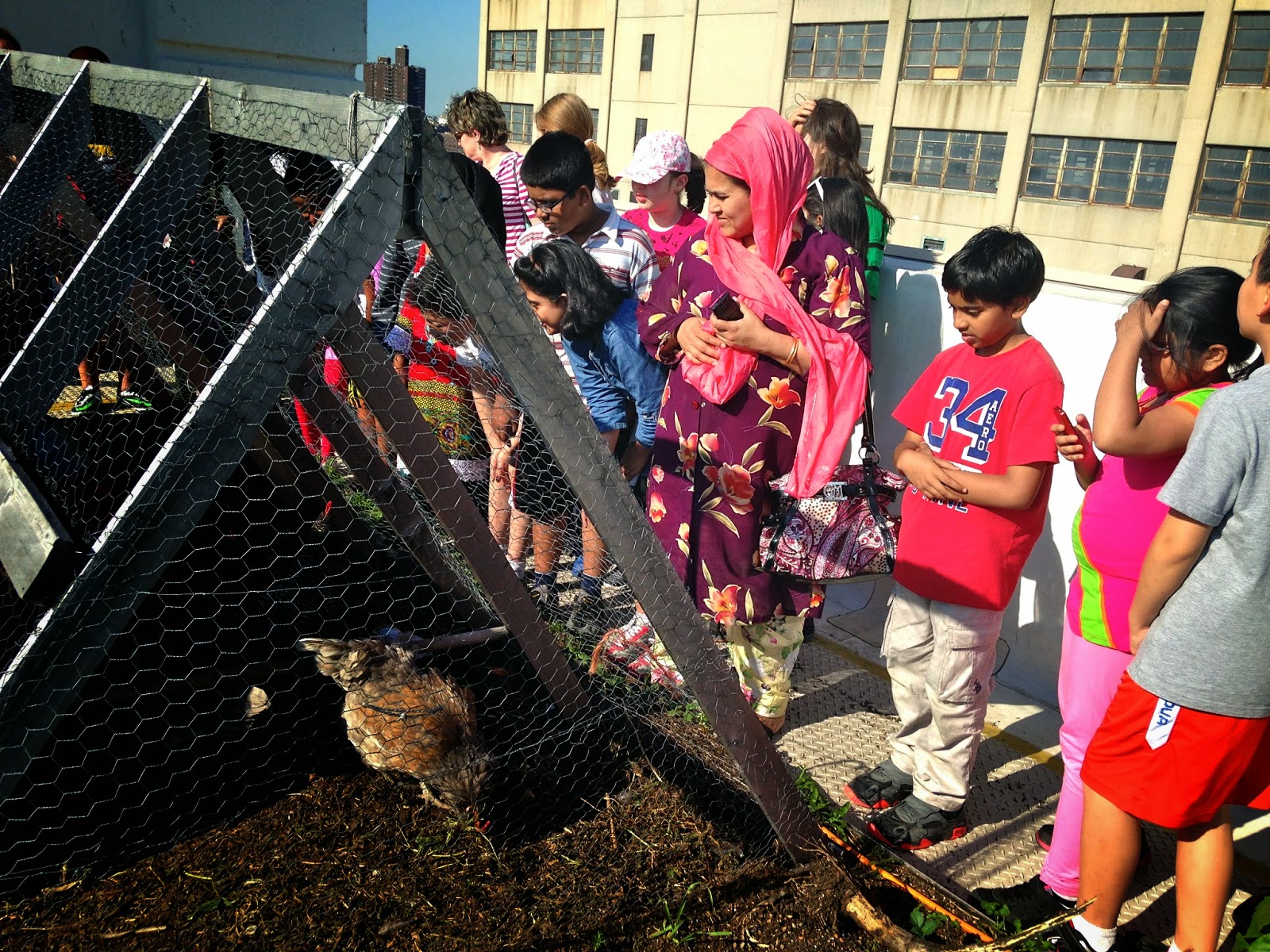
If you want to visit a farm, look no further than....Brooklyn, New York! That's what some of P.S. 230's fifth-graders learned during a recent after school trip to Brooklyn Grange. The farm, which opened in 2012, is 12 stories up on Building 3 at the Brooklyn Navy Yard. It's a commercial farm, which means it grows its produce to sell. Some area restaurants are buyers and the farm has a CSA, which stands for Community Supported Agriculture. As a CSA member,  you pay a membership fee in the winter, which helps to support the farmer during the growing season. Then each week, the farmer delivers freshly-picked produce to Brooklyn, where its picked up by the member.

The farm also has an apiary, which is another word for bee hives. The honey made by the bees is also sold by the farm. Fresh Brooklyn honey!
The colorful boxes in the background house the bees
There are rows and rows of vegetables, especially all kinds of salad mixes
The farm overlooks the waterfront. After all, this used to be the Brooklyn Navy Yard.
Our tour guide, Nicki, was quite knowledgeable

Sarah and Maddy sharing their worms
 We also got to poke around the farm's worm bin. Students picked their favorite worms and watched them squiggle and wiggle before putting them back.
Tasfiya seems to like her worm

Fatima is protecting her worm from the sun

Sanjida shows off her worm for the camera

Hasib checking out Tasifya's new friend
Robayah wants in on the worm fun
Worms make people happy, right Taosif?
Kaseng and Taosif share worms
Nicki then took everyone over to the farm's chicken coop. Here she explained that egg colors vary...blue, brown, beige white...and that is because of the color of the hen's earlobes. I never even thought about chicken's having earlobes!


Estrella has a question for Nicki


Students also got to taste some lemony sorrel and spicy arugula and smelled licorice-scented anise and refreshing mint!

Yes, that's the Empire State Building in the background. I bet no Iowa farm can top this backdrop!

The farm was amazing and so large. And this isn't the only farm run by Brooklyn Grange. Their flagship farm is in Long Island City, Queens, where they host free open houses on the weekend.

 Click here for more information.