If you plan on coming on the horseshoe crab walk along Plumb Beach on Sunday, please let me know so I can expect you.
Meeting time: 8:30 A.M., Sun., May 20, 2012
Directions to Plumb Beach: Take Ocean Parkway (toward ConeyIsland) to the Belt Parkway East. After Exit 9, move into the right lane. You will be getting off soon. Look carefully on the right for a parking lot and pull in. This is the Plumb Beach parking lot. If you reach Exit 11 (Flatbush Ave.), you have gone too far. If you are lost, call me at (917) 945-9696.
Thursday, May 17, 2012
FOURTH GRADE SCIENCE TEST COMING UP!
It's time to put on your science thinking caps. The hands-on portion of the state science test begins on Wed., May 23, 2012 and ends on June 1, 2012. Students will be scheduled in different groups. The written exam takes place June 4, 2012 in the student's classroom.
Please study your science notebook, go to brainpopjr.com, and read, read, read. Practice your vocabulary. And remember, never forget to write the unit of measure (centimeters, milliliters, degrees, grams) because you will lose a point each time you forget. Eyeballs, eyeballs, eyeballs......
Do your best work and never stop trying as hard as you can! I'm on your side kids!
Friday, April 13, 2012

Tuesday, March 20, 2012
New York City is NATURE CENTRAL!
Kids are always amazed when I tell them that hawks and owls nest in New York City. Here's another example of nature co-existing with the city--two red-tailed hawks perched on a 12th floor ledge of a building near Washington Square Park in Manhattan. What a view they have from their cozy, little home. You can watch these predators (and their two eggs!) 24/7 by tuning to Hawk Cam 2012, a partnership between The New York Times and New York City Audubon. The address to spy on these carnivores is: http://cityroom.blogs.nytimes.com/2012/03/12/the-hawk-cam-is-back-for-another-season. Happy virtual birding!
Wednesday, February 1, 2012
WHAT ARE THOSE CREEPY THINGS IN MS. SEITZ'S ROOM?
They are the life cycle of the darkling beetle. The yellow worm-like creature isn't a worm at all. It's a meal worm, the larvae or young of the beetle. If you look closely, you will see six insect legs. And that whitish, sleepy-looking thing is a grub or the pupa of the beetle. It will stay this way for about three weeks, before COMPLETE METAMORPHOSIS occurs, changing it into an adult beetle. (The next stage in the life cycle would then be the egg.)WHAT OTHER CREATURES DO YOU KNOW THAT GO THROUGH COMPLETE METAMORPHOSIS? SHARE!
The meal worms and beetles are handy food for the classroom anoles.
The students like them too! (Not to eat, of course, to OBSERVE!)
Tuesday, January 24, 2012
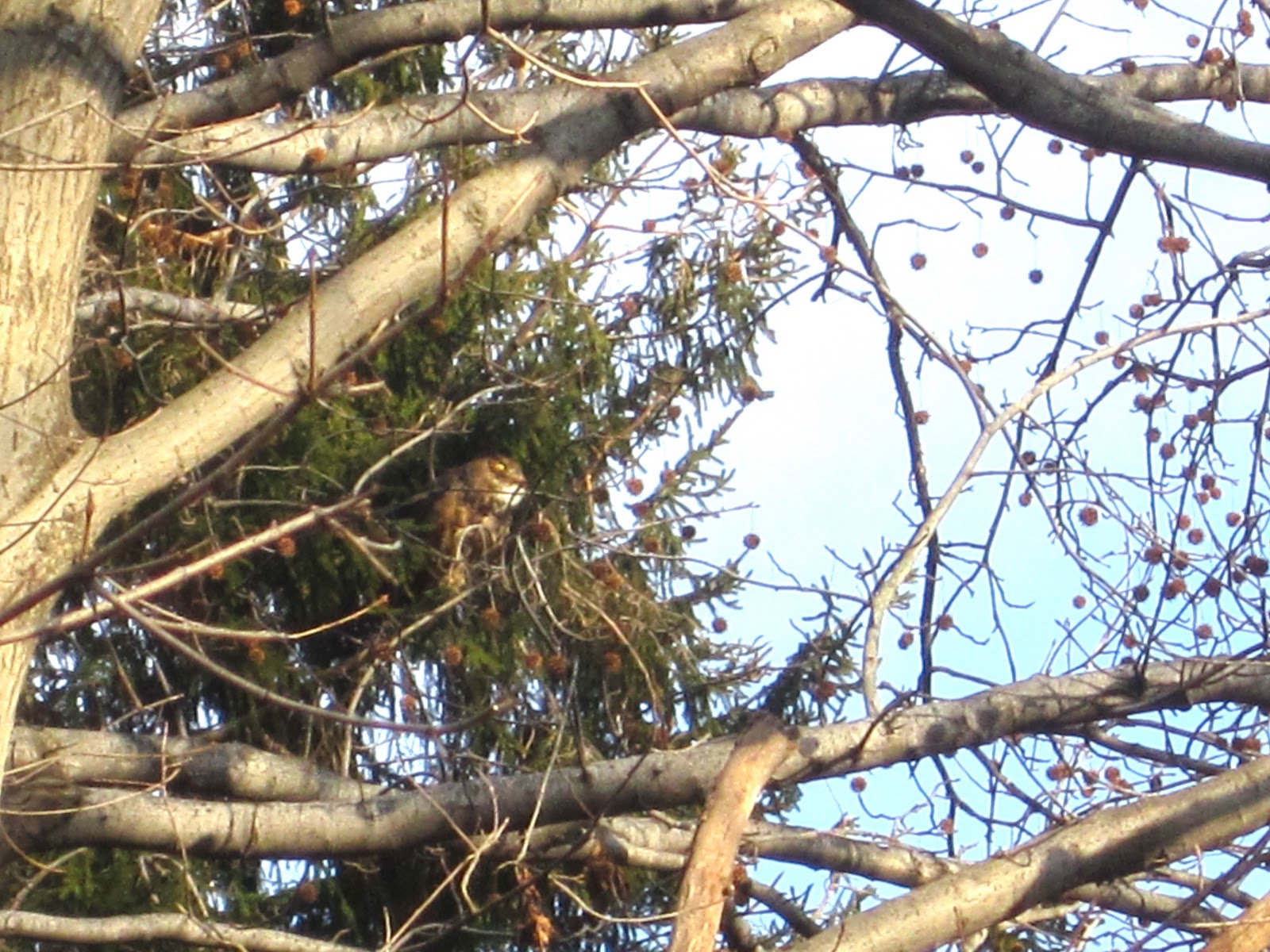
It's not every day that you see a Great Horned Owl in a tree in Prospect Park. But that's what happened to me today and it was so exciting! I saw the female, a huge lady! and even had her look right at me with her piercing yellow eyes. She even spoke in her traditional owl way: hoo hoohoo hoo hoo hoooo hoooo. The experience was incredibly awesome!
Now, it's not easy finding an owl in the woods. All I knew was that it was in a certain location in a Norway Spruce. I felt a bit like a detective with my map of Prospect Park and binoculars. I ended up looking up the wrong tree for a while and had to google "Norway Spruce" to remind myself of what it looked like. I think I was looking at a white oak by mistake. So, I circled around a bit, staying in the general area and looking for an evergreen tree. Owls perch in these because they provide needed camouflage and privacy (apparently crows like to hassle them). Deciduous trees--which make up the bulk of wooded area--don't have leaves this time of year.
I was thrilled and a little proud of myself when I found the right tree species, but then a little bummed that I couldn't find the owl. So just picture Ms. Seitz, binoculars around her neck, reading glasses perched just above her lip, camera wrapped around her wrist, and toting a big bag of other stuff, tripping over saplings and running into bushes just trying to get the best vantage point to see the owl. This took some time and some doing. A couple of people passed by and didn't pay any great attention to me, but for the most part I was alone in my determination to see the owl. And then, it happened. I saw what looked like brown feathers. I focused my binoculars and stared. Yes, feathers! Yes, a huge owl! I must have stared at the owl for close to an hour. Occasionally the owl moved her head and even looked at me for a while with those golden eyes. I even saw her scratch an itch she had. I snapped some photos, which admittedly are pretty awful, but they are here in all their blurry glory to prove that an amazing Great Horned Owl (and her mate...who I didn't see) lives in Brooklyn!
So why is this so cool and unusual? Well from what I hear from birders, Great Horned Owls have not nested successfully in Brooklyn in 100 years! So let's hope this pair likes it here and sets up a nest in the tree, and lay eggs, and raises young. Just how exciting would that be? Also, we don't see lots of owls in Brooklyn compared to say, pigeons, starlings and house sparrows, so just seeing an owl in this urban environment is downright wonderful! I feel so lucky!
Now, if you want to hear the Great Horned Owl, check out this link:
http://www.birdjam.com/#
Now, it's not easy finding an owl in the woods. All I knew was that it was in a certain location in a Norway Spruce. I felt a bit like a detective with my map of Prospect Park and binoculars. I ended up looking up the wrong tree for a while and had to google "Norway Spruce" to remind myself of what it looked like. I think I was looking at a white oak by mistake. So, I circled around a bit, staying in the general area and looking for an evergreen tree. Owls perch in these because they provide needed camouflage and privacy (apparently crows like to hassle them). Deciduous trees--which make up the bulk of wooded area--don't have leaves this time of year.
I was thrilled and a little proud of myself when I found the right tree species, but then a little bummed that I couldn't find the owl. So just picture Ms. Seitz, binoculars around her neck, reading glasses perched just above her lip, camera wrapped around her wrist, and toting a big bag of other stuff, tripping over saplings and running into bushes just trying to get the best vantage point to see the owl. This took some time and some doing. A couple of people passed by and didn't pay any great attention to me, but for the most part I was alone in my determination to see the owl. And then, it happened. I saw what looked like brown feathers. I focused my binoculars and stared. Yes, feathers! Yes, a huge owl! I must have stared at the owl for close to an hour. Occasionally the owl moved her head and even looked at me for a while with those golden eyes. I even saw her scratch an itch she had. I snapped some photos, which admittedly are pretty awful, but they are here in all their blurry glory to prove that an amazing Great Horned Owl (and her mate...who I didn't see) lives in Brooklyn!
So why is this so cool and unusual? Well from what I hear from birders, Great Horned Owls have not nested successfully in Brooklyn in 100 years! So let's hope this pair likes it here and sets up a nest in the tree, and lay eggs, and raises young. Just how exciting would that be? Also, we don't see lots of owls in Brooklyn compared to say, pigeons, starlings and house sparrows, so just seeing an owl in this urban environment is downright wonderful! I feel so lucky!
Now, if you want to hear the Great Horned Owl, check out this link:
http://www.birdjam.com/#
Sunday, January 22, 2012
Lego Master Builders
I know that many of you love building with Legos, did you know that you can become a Master Builder when you grow up? But it's not that easy.....read on and learn what it takes to become one! (By the way, the story was written by sixth-grader Lucas Miller, who also happens to be my son!
For Christmas, my brother and I got
4,287 pieces of colored plastic. We were extremely excited. These weren’t
random bits of plastic, they were part of a Lego set of London’s Tower Bridge.
But that’s nothing compared to the 20,000 bricks in the giant Whale’s Tail or
the 304,500 bricks used to create Neptune in an exhibit at the Sydney Aquarium.
Millions
of people around the globe play with Lego but not many can name the people
behind the gigantic and beautiful plastic brick creations seen in storefronts,
theme parks and museums and places. These are the works of the Lego Master
Builders. I
already knew a lot about Lego in general but since I didn’t know much about
Lego Master Builders I chose to make them the focus of my I-Search paper.
I
wanted to learn what Master Builders do and who they are. I really wanted to uncover the history
of the Lego Master Builder. I wanted to know who had created the position, and
how the job has changed over the years. I also wanted to discover how someone
could become a Master Builder and the different duties they would have before
becoming a full-fledged master. Another thing I wanted to know was how many
Masters there are, and who they are. But most of all I wanted to find about the
creations they make, and how they are designed.
Since
Lego is extremely popular, I thought there would be loads of information on the
Master Builders. But... there wasn’t. The Lego Book, by Daniel Lipkowitz, which
I own, had a two-page spread but it is mostly pictures and has very little information.
My dad helped me check the New York Times’ entire archives since 1851 and there
was nothing on Master Builders. When I first Googled the topic, I found a June
2010 story by a WBEZ radio producer in Chicago at
www.marketplace.org
about a Master Builder named Daniel Morey but it didn’t have much information.
Very few Google results contained
any useful facts. Many were promoting Lego, especially the company’s “Master
Builder Academy,” in which kids learn how to build with Legos.
I felt very frustrated. I almost
gave up and wanted to change my topic. I asked my dad for help and he showed me
how to put words in quotes in Google and how to refine my search.
Finally,
I found three good websites with stuff about my topic: zakkalife.blogspot.com
(October 2011), geekmom.com (June 2011), which I only found through something
on wired.com, and geekadelphia.com (March 2010). But then one site that just
had Lego images, www.antalik.com, led me
to another good site, www. Fbtb.net, (August 2005), after I clicked on the
Neptune picture just because I wanted to see it up close.
Zakkalife
had an interview with Lego Master Builder Steve Gerling, Geekmom had an article
about Gerling that also had some Master Builder history, Geekadelphia had an
interview with a different Master Builder, named Pete Donner, and fbtb had an
interview with Master Builder Erik Varszegi. Most of the people who published these articles/interviews
do not have any real journalistic credentials, they are mostly just Lego geeks
with blogs about Lego, but considering that most of the stuff I found were just
Q&As, I don’t really think credentials are necessary. They were very
informative and answered most of my questions.
I
learned from the geekmom site that the job of Master Builder was created in
1961 by Dagny Holm, who was the niece of one of Lego’s founders. Today, there
are Master Builders at the U.S.
headquarters in Enfield, Connecticut, the world headquarters in Denmark, inthe
Czech Republic, and in all of the Legoland theme parks (here in America, in
Denmark, Germany, and the United Kingdom). Some of these people started out as
artists, either painters or sculptors or woodworkers but some came from other
backgrounds, as scientists or even clowns.
In
the Pete Donner interview, I learned that Master Builders have to start just as
model gluers doing basic work and then move up to being a model builder before
eventually getting promoted to Master Builder.
In
the Steve Gerling interview, which is the most up-to-date information I found,
I learned that there are seven Master Builders at Lego in America but that they
also use six or eight freelancers. One thing I learned in the Gerling interview
and in the Varszegi interview that really surprised me is how much of their
work today is done using computers.
“We
do a lot of our prototyping for our big models on software that the Lego
company developed that allows us to take a virtually designed generic model and
turn it into a virtual Lego model that can be used for a prototype,” Gerling
says. “We can copy that layer by layer.”
And
Varszegi comments, “If we were to grow the
department it would be helpful to have an art or architecture background like
some of us here. Also these days, like most jobs, we are relying more and more
on computer skills. We make use of 3D software like 3DStudiosMax, Maya and
Poser. AutoCAD, we use that a lot and graphics programs like Photoshop. “
One
quote I really liked from Gerling showed that they don’t build the commercial
sets that my brother and I might build and also about creativity. “We're
not the ones who design the set that you buy in stores,” he says. “Our job is
to promote the imagination.”
I
really learned a lot about Lego Master Builders and I was glad that I learned
from the actual Master Builders themselves.. Even though the research part was
frustrating, I think it taught me more about how to do research on a specific
topic. I don’t think there is any more I need to learn about this topic but I
think that whatever the next topic I need to do research on may be I will be
more prepared to do the job.
Subscribe to:
Posts (Atom)